Showing posts with label wiki. Show all posts

Thursday, June 5, 2008

#94


Cool is an aesthetic of attitude, behavior, comportment, appearance, style and Zeitgeist. Because of the varied and changing connotations of cool, as well its subjective nature, the word has no single meaning. It has associations of composure and self-control (cf. the OED definition) and often is used as an expression of admiration or approval.

Tuesday, February 12, 2008

#76

The titis, or titi monkeys, are the New World monkeys of the genus Callicebus. They are the only extant members of the Callicebinae subfamily, which also contains the extinct genera Xenothrix, Antillothrix (German article), Paralouatta, Carlocebus, Homunculus, Lagonimico and possibly also Tremacebus.

Titis live in South America, from Colombia to Brazil, Peru and north Paraguay.

Titis are monogamous, mating for life. The female bears a single young animal after about a five-month gestation. Twins occur rarely.[citation needed] The more "laid-back" adult cares for the young.[citation needed] Often it is the father who cares for the young, carrying it and bringing it to the mother only for nursing. The young are weaned after 5 months and are fully grown after two years. After three or more years, they leave their family group in order to find a mate. Their life expectancy is up to 12 years in the wild.

Monday, February 11, 2008

#75

Bowerbirds (IPA: [ˈbaʊəˌbɜːd(UK)/ˈbaʊɚˌbɝːd(US)]) and catbirds make up the family Ptilonorhynchidae. All are small to medium in size. Although their distribution is centered around the tropical northern part of Australia-New Guinea, some species extend into the central Australian desert and the cold mountainous regions of southeast Australia.

The most notable characteristic of bowerbirds is the extraordinarily complex behaviour of males, which is to build a bower to attract mates. Depending on the species, the bower ranges from a circle of cleared earth with a small pile of twigs in the center to a complex and highly decorated structure of sticks and leaves — usually shaped like a walkway, a small hut or a maypole — into and around which the male places a variety of objects he has collected. These objects — usually strikingly blue in hue — may include hundreds of shells, leaves, flowers, feathers, stones, berries, and even discarded plastic items or pieces of glass. The bird spends hours carefully sorting and arranging his collection, with each object in a specific place; if an object is moved while the bowerbird is away he will put it back in its place. No two bowers are the same, and the collection of objects reflects the personal taste of each bird and its ability to procure unusual and rare items (going as far as stealing them from neighboring bowers). At mating time, the female will go from bower to bower, watching as the male owner conducts an often elaborate mating ritual and inspecting the quality of the bower. Many females end up selecting the same male, and many underperforming males are left without mates.


http://www.cryptolizard.com/blog/?p=126

Wednesday, January 23, 2008

#71


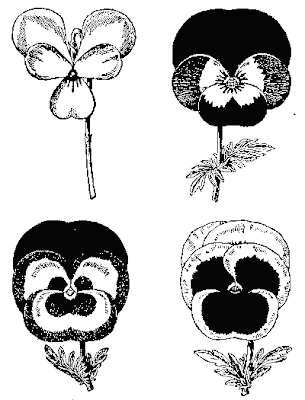
The pansy or pansy violet is a plant cultivated as a garden flower. Pansies are derived from Viola tricolor also called the Heartsease or 'Johnny Jump Up'. However, many garden varieties are hybrids and are referred to as Viola × wittrockiana but sometimes they are listed under the name Viola tricolor hortensis. The name "pansy" also appears as part of the common name of a number of wildflowers belonging, like the cultivated pansy, to the genus Viola. Some unrelated species, such as the Pansy Monkeyflower, also have "pansy" in their name.

The name pansy is derived from the French word pensée meaning "thought", and was so named because the flower resembles a human face; in August it nods forward as if deep in thought. Because of this the pansy has long been a symbol of Freethought[1] and has been used in the literature of the American Secular Union. Humanists use it too, as the pansy's current appearance was developed from the Heartsease by two centuries of intentional crossbreeding of wild plant hybrids. The Freedom From Religion Foundation (FFRF) uses the pansy symbol extensively in its lapel pins and literature.

The word "pansy" has indicated an effeminate male since Elizabethan times and its usage as a disparaging term for a man or boy who is effeminate (as well as for an avowedly homosexual man) is still used. (There is a queercore musical band called Pansy Division, drawing on this association.) The word "ponce" (which has now come to mean a pimp) and the adjective "poncey" (effeminate) also derive from "pansy".

The pansy remains a favorite image in the arts, culture, and crafts, from needlepoint to ceramics. It is also the flower of Osaka, Japan.

* In 1827, Pierre-Joseph Redouté painted Bouquet of Pansies.
* In 1926, Georgia O'Keeffe created a famous painting of a black pansy called simply, Pansy. She followed with White Pansy in 1927.
* D. H. Lawrence wrote a book of poetry entitled Pansies: Poems by D. H. Lawrence.
* In William Shakespeare's play A Midsummer Night's Dream, the juice of a pansy blossom ("before, milk-white, now purple with love's wound, and maidens call it love-in-idleness") is a love potion: "the juice of it, on sleeping eyelids laid, will make or man or woman madly dote upon the next live creature that it sees." (Act II, Scene I see also: Oberon at II, i). Since the cultivated pansy had not yet been developed, "pansy" here means the wild Heartsease, and the idea of using it as a love potion was no doubt suggested by that name. The folkloric language of flowers is more traditional than scientific, with conventional interpretations, similar to the clichés about animals such as the "clever fox" or "wise owl". Ophelia's oft-quoted line, "There's pansies, that's for thoughts", in Hamlet (Act IV, Scene V) comes from this tradition: if a maiden found a honeyflower and a pansy left for her by an admirer, it would mean "I am thinking of our forbidden love" in symbol rather than in writing.

Friday, September 7, 2007

#29

A balut (Trứng vịt lộn or Hột vịt lộn in Vietnamese, Pong tea khon in Cambodian) is a fertilized duck egg with a nearly-developed embryo inside that is boiled and eaten in the shell. They are considered delicacies of Asia and especially the Philippines, Cambodia, and Vietnam. Popularly believed to be an aphrodisiac and considered a high-protein, hearty snack, baluts are mostly sold by street vendors at night in the regions where they are available. They are often served with beer. The Filipino and Malay word balut(balot) roughly translates to mean "wrapped".

wiki/Balut